

What Was the First Creepypasta Ever Written?
It’s hard to track the history of creepypastas, as there are too many of them that appeared anonymously. Decades ago, good creepypastas were copied from one website to another and spread the way viruses spread. Because of this, nobody really knows who wrote many famous stories or where they were first published.
If you’re familiar with the world of creepypasta, you may assume that either Slender Man, Jeff the Killer, or Smile Dog was the first character to frighten internet users. But the reality is that they became famous years after online horror stories had already started spreading.
So, which story started the creepypasta genre in the first place?
Perhaps not surprisingly, the answer isn’t simple and straightforward. Still, there’s usually one story that is described as the first modern creepypasta by users from those times. That first-ever creepypasta is Ted the Caver, which appeared online in 2001 and made readers believe that they were following a real man as he explored something terrifying beneath the ground.
In this article, we’ll remind you of that story and explore why Ted the Caver has become such an important part of internet horror.
What Does the Word Creepypasta Mean?
To understand what the first creepypasta ever written was, you may need to first understand what the word “creepypasta” itself means. Well, if you’re a long-term user of this platform, maybe this word doesn’t even sound odd anymore, but actually, it didn’t exist before internet culture.
“Creepypasta” is a combination of “creepy” and “copypasta.” Copypasta itself is a piece of text that users copy and paste across different websites or forums. The reason it was replaced by the word “creepy” is that it described frightening stories that spread through repeated copying and pasting.
Back then, the internet looked completely different. These days we can find entertainment literally everywhere online, whether it’s watching videos, scrolling through social media, or visiting gaming platforms such as Betinia New Jersey. But early internet users indeed had very limited options, and they had to entertain one another by sharing strange stories through emails, forums, and personal websites.
Since these stories were copied so many times, the original author’s name often disappeared along the way. That’s one reason why identifying the first creepypasta ever written is so difficult.
Was Ted the Caver the First Creepypasta?

Nevertheless, if you search for the first-ever creepypasta, you’ll find the story about Ted the Caver almost everywhere on the internet. This famous creepypasta was written by Ted Hegemann. However, instead of the creepypasta forum, he first published the story on a personal Angelfire website in 2001. In fact, it was several years before internet users even started using the word “creepypasta.”
The story of Ted the Caver came as a series of online journal entries. In each of them, the main character told the reader about his attempts to explore a narrow passage inside a mysterious cave with his friend, known only as B. In the beginning of the entries, you will encounter only ordinary caving details, but as the story proceeds, it becomes more and more frightening.
The thing that made this first creepypasta even more frightening is that Hegemann also included real photographs and detailed descriptions of the equipment the characters used. Because of this, many readers believed that they were following an actual caving expedition, which was really rare at that time.
The final entry made the story even more mysterious, as Ted announced that he was returning to the cave and promised to update the website afterward. Obviously, he never did.
Why Did Ted the Caver Become So Famous?
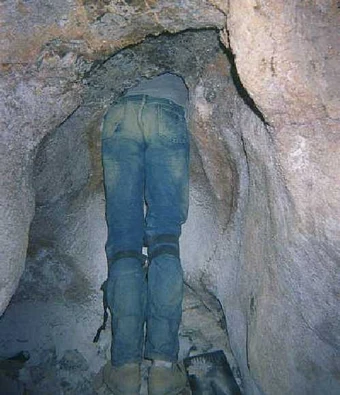
Looking back at the time when creepypastas were starting to appear, it’s easy to understand why Ted the Caver attracted so much attention. The story didn’t look like fiction at all. It was more of a personal website created by an ordinary man who simply documented his caving adventures. Nothing much surprising at first glance. However, somehow this simple website originated the entire style of internet horror.
The thing that hooked the readers so much is probably related to the realistic details of the story.
Ted included real photographs and explained how he and his friend widened a narrow hole to enter an unexplored part of the cave. Therefore, the story seemed real from top to bottom. There were even details about the equipment and the physical difficulties they experienced underground. Because of all this, strange winds, unexplained sounds, and mysterious symbols were perceived as reality, and readers didn’t even question the narrator.
Were There Creepypastas Before Ted the Caver?
Technically, frightening stories were spreading online long before Ted the Caver appeared in 2001. Internet users shared urban legends through bulletin boards, Usenet groups, forums, or just emails throughout the 1990s. Most of these stories were copied without the original author’s name. And that’s when the horror stories started behaving like modern creepypastas — there was no way someone could discover who wrote them or whether the events were real.
However, all these early stories were nothing more than simple blocks of text. But Ted the Caver was different. After all, Hegemann added photographs, hyperlinks, journal entries, and regular updates. So it was a proper story. full-length story with all the visual material that readers needed to believe it was real. Besides, readers didn’t receive the entire story at once and followed Ted’s experience as if the frightening events were happening in real time.
Because of this, it’s impossible to identify the first creepypasta with complete certainty. However, Ted the Caver is still widely considered the first modern example that introduced the realistic style of online horror storytelling.
Copyright Statement: Unless explicitly stated, all stories published on Creepypasta.com are the property of (and under copyright to) their respective authors, and may not be narrated or performed under any circumstance.